The term ‘sustainable’ is used often these days, but what exactly does the term ‘sustainable landscape’ mean, especially in relation to the field of Landscape Architecture? According to the American Society of Landscape Architects (ASLA), a sustainable landscape is one that “reduces long term economic costs associated with a site.” In order to reduce these long term costs, however, a number of strategies must be employed such as “implementing permeable streets and driveways, bioswales, rain gardens and bioretention ponds.” All together, these strategies amount to an LID or Low Impact Development approach to development because they reduce the overall costs by limiting the quantities of materials needed to make a landscape functional.
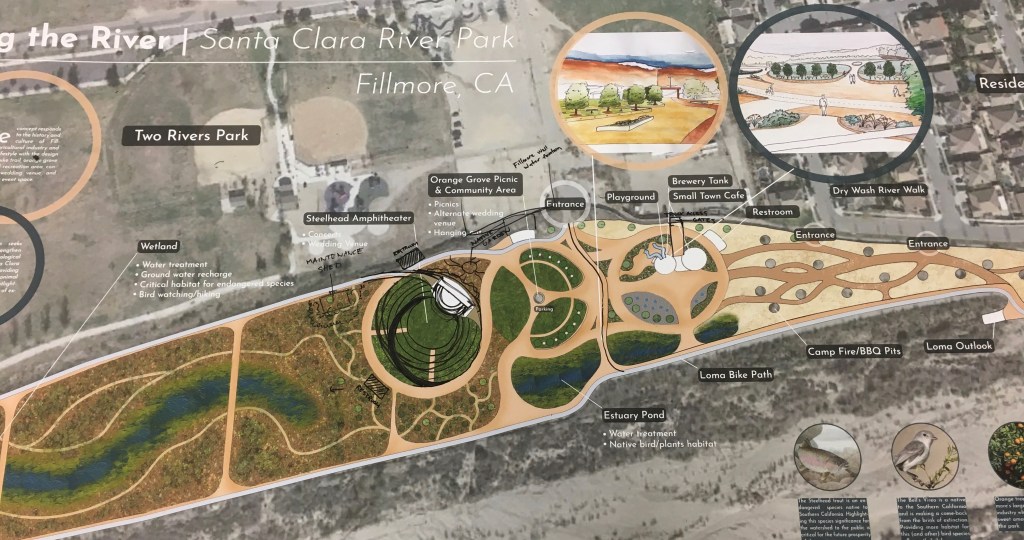
For Fillmore CA, the adaptive reuse of post industrial landscapes offers a chance to transform a derelict wastewater treatment plant into an economically viable and productive city park. According to ASLA, “the long-term economic value of a sustainable site can be calculated through a sustainable return on investment (SROI) approach.” This approach seeks to maximize the clients “triple” bottom line: economic, environmental, social. Using these three metrics, I show how my re-design of this site just north of the Santa Clara River meets the “triple-bottom line” benchmark and justifies designation as a sustainable landscape.
First, my park redesign (henceforth called the Santa Clara River Park) incorporates multiple opportunities for revenue generation; a local brewery and cafe located inside the two former water tanks, venue space for weddings, markets, and an amphitheater for concerts and theatrical productions. These activities have enormous potential for large economic generation. Second, the Santa Clara River Park embodies a forward thinking approach to storm water management and conservation through its multiple retention ponds, constructed wetlands, and native planting design. Lastly, various social/community networks are incorporated on site including a two lane bike path, rock climbing wall, child playground, BBQ/grilling pits, and wildlife observation experiences. A core principle of my design is to design each area the ability to perform multiple economic, environmental and social functions within the park, increasing its benefit to the community and its sustainability as a landscape.

 Sustainable Design & Development in Landscape Architecture